I-Ching and the Tao: Philosophical Foundations of Change and Harmony
Published on August 11, 2026
The Living Wisdom of the I-Ching
"The I-Ching is not just a divination tool – it's a living expression of the Tao." This ancient text, also known as the Book of Changes, has guided Chinese philosophy for over three millennia. At its core lies a profound understanding of the universe as a dynamic, ever-flowing interplay of forces. The I-Ching does not predict a fixed future; instead, it reveals the underlying patterns of change, offering a mirror to the Tao – the ineffable source of all existence.
To truly grasp the I-Ching, one must first understand its philosophical bedrock: the Taoist worldview. The Tao (道) is the nameless, formless principle that gives rise to all phenomena. It is not a deity but the natural order of the cosmos. The I-Ching translates this cosmic order into a symbolic language of hexagrams, each representing a specific moment in the flow of yin and yang. This is why the I-Ching is often called the "I-Ching Tao philosophy" – it is the most direct literary expression of Taoist thought.
Yin Yang: The Dance of Opposites
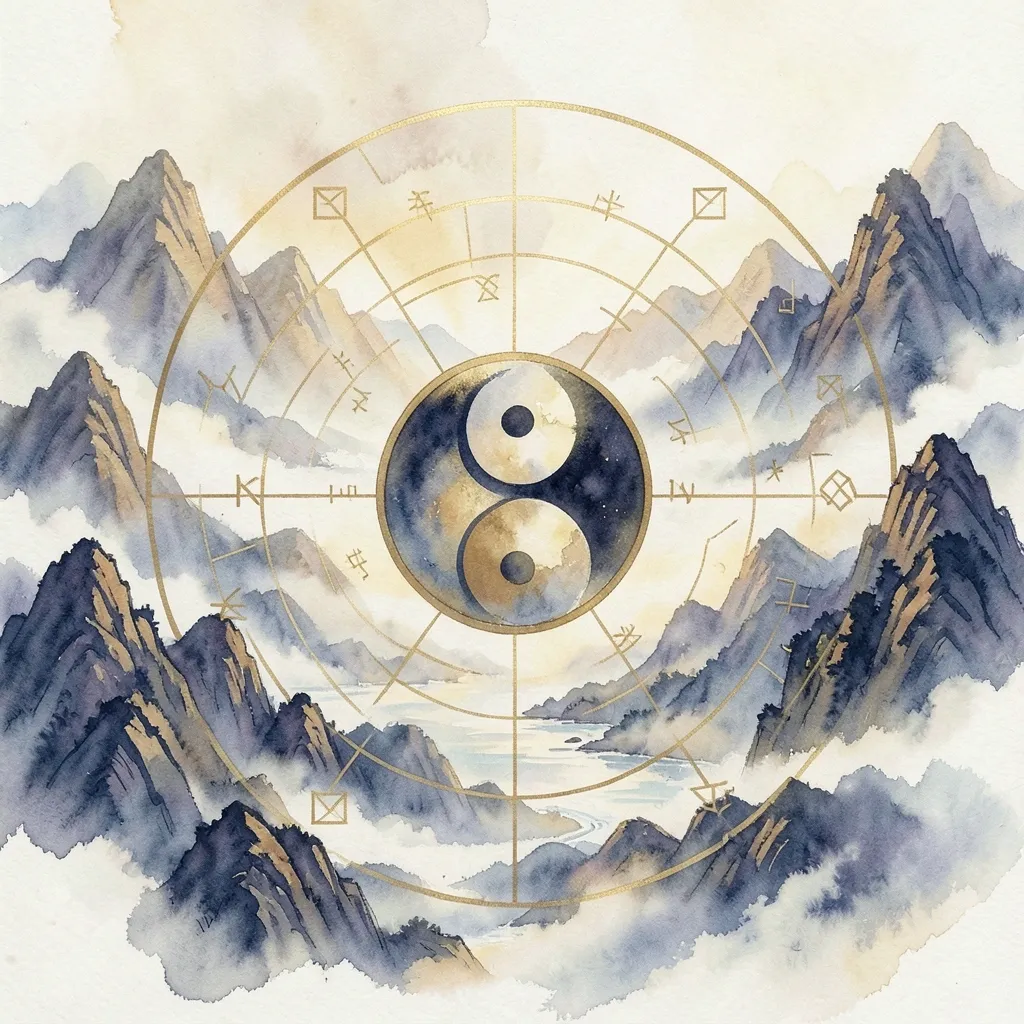
Central to both the I-Ching and Taoism is the concept of yin yang. Yin and yang are not opposing forces but complementary poles of the same energy. They represent the dualities that define life: light and dark, activity and stillness, expansion and contraction. The I-Ching's 64 hexagrams are built from six lines each, which can be either broken (yin) or solid (yang). These lines stack to form a unique symbol that captures a specific phase of the cosmic dance.
When you cast a hexagram using the I-Ching, you are not gambling; you are tapping into the resonance of the moment. The ancient Taoist sages believed that the pattern of yin and yang at any given time reflects the state of the Tao itself. By studying the hexagram, you gain insight into how to align with the natural flow of events. This is the essence of I-Ching Tao philosophy: understanding when to act and when to yield, when to push forward and when to retreat.
The Structure of the I-Ching: A Map of Change
The I-Ching consists of 64 hexagrams, each with a name, a judgment, and a set of line statements. These are not arbitrary; they are derived from the interplay of the eight trigrams (bagua), which themselves represent fundamental natural forces: Heaven, Earth, Water, Fire, Thunder, Wind, Mountain, and Lake. The trigrams combine to form hexagrams, creating a comprehensive system for describing all possible situations in life.
For example, Hexagram 1 (Qian, The Creative) is composed of six yang lines, embodying pure creative energy, initiative, and the power of the heavens. Hexagram 2 (Kun, The Receptive) is six yin lines, representing complete receptivity, nurturing, and the earth. Together, they illustrate the primal duality of yin and yang. Every other hexagram is a blend of these two archetypes, reflecting the infinite variety of human experience.
To use the I-Ching effectively, one must approach it with a clear question and a sincere heart. The traditional method involves tossing three coins six times, recording the resulting yin or yang lines. This process creates a hexagram that is then interpreted. The I-Ching's wisdom is not in providing direct answers but in offering a perspective that helps you see the situation from a higher, Taoist viewpoint.
From Divination to Philosophy: The I-Ching in Daily Life
Many people first encounter the I-Ching as a divination tool, but its deeper purpose is philosophical. The I-Ching teaches that change is the only constant, and that harmony arises from aligning with the Tao. This is the core of I-Ching Tao philosophy. By studying the hexagrams, you learn to recognize patterns in your own life – the waxing and waning of fortune, the cycles of growth and decay. You begin to see that every situation contains the seeds of its opposite, a key insight from yin yang theory.
For example, the hexagram "Pi" (Stagnation) represents a period of blockage and difficulty. Yet the I-Ching does not counsel despair; it advises patience and inner cultivation, because stagnation eventually gives way to prosperity. This cyclical view of time is deeply Taoist. The sage does not force outcomes but waits for the natural turning point.
Modern psychology has also recognized the value of the I-Ching. Carl Jung called it a method of "synchronicity" – meaningful coincidences that connect the inner world of the psyche with the outer world of events. Jung's work on archetypes parallels the I-Ching's hexagram system, which can be seen as a set of universal archetypes describing human experience.
How to Study the I-Ching Today
While the I-Ching is an ancient text, its wisdom remains accessible. Many modern tools make it easier to explore this profound system. For instance, the Quantum I-Ching Oracle on the YuanYu platform provides a digital version with the full 64 hexagram library. You can cast a hexagram instantly and receive the classical judgment. However, the true power of the I-Ching is unlocked when you combine it with your personal astrological chart, such as your True Solar Time Bazi Calculator, which reveals the energetic blueprint of your life.
For those seeking a deeper connection, the YuanYu Destiny Box offers a revolutionary hardware experience. This Spiritual Tech device contains a physical Quantum Random Number Generator (QRNG) chip, which captures subatomic noise from the environment to generate truly random hexagrams. This grounds the digital act of divination in a physical, chaotic event – just as the ancient ritual of yarrow stalk casting required the randomness of the physical world. The Destiny Box also syncs with your Bazi chart to provide personalized light, sound, and haptic feedback, creating a holistic cultivation practice.
If you are new to the I-Ching, consider starting with the Plum Blossom Divination (Meihua Yishu), a faster method that uses random numbers to generate hexagrams. This method is based on the Ti-Yong (Body-Application) principle, which helps you separate your own energy from the situation you are inquiring about. Over time, you can graduate to the full I-Ching oracle and even explore the Takashima Ekidan Master Oracle for advanced interpretations.
Conclusion: The Tao of Modern Life
The I-Ching is not a relic of the past; it is a living philosophy that speaks to the challenges of the modern world. In an age of information overload and constant change, the I-Ching Tao philosophy offers a grounding perspective. It reminds us that every situation is part of a larger pattern, and that true wisdom lies in harmonizing with the flow of the Tao, not fighting against it.
Whether you use the I-Ching for personal guidance, business strategy, or spiritual cultivation, the key is to approach it with an open mind and a willingness to learn from the symbols. The ancient Taoist masters understood that the universe is a mirror of the soul, and the I-Ching is the lens that brings that reflection into focus. Start your journey today with the tools available on YuanYu, and discover how the timeless wisdom of the I-Ching can illuminate your path.
To deepen your practice, try the AI Astrologer & Oracle Chat, which combines the I-Ching with your personal chart for personalized insights. Or explore the Yuan Tian Gang Bone Weight Calculator to understand your inherent destiny. The Tao is vast, but the I-Ching is a compass that never fails.